3.04.2010

Dissonance: My artwork changing in style

As of late, I have started to change my ideas of how to express my issues with my own identity. With some help from Tom though, I got the ball rolling again. I started searching for ways to express my conflict and internal issues in more ways that could still be drawn back to the same ideas of before, with the same concept, but have a totally different face and image makeup. I started thinking of how I could express a separation, an actual view of ‘two of me’ within a piece without starting to become heavily dependant on Adobe Photoshop, and the post-production of my imagery. I thought back to images of past, where I was in a reflection of a glass pane of sorts, but was not pictured in the actual image. My concept of ‘the struggle’, which has been a running theme throughout all of my work here at VCU, stemmed first from these images, and still feel as if they are some of the strongest pieces I have done. Here are a few examples below.


These pieces got me to think of how I could incorporate myself within an image, and be pictured twice in an image, without questions being asked of where the other ‘me’ came from. I then thought how I could change this shot to resemble the state of myself being separated or being dissonant from one me to the other, as if each one of me, the reflection, and the actual, each stood one representing the Kenyan side, and the other representing the American side. The dissonance and separation between the two of me in the image needed to be pictured realistically, but also needed to clearly show a confusion or separation. I finally thought of the idea of me flipping the reflection of me in one of the images from being a picture that makes sense, to one in which the reflection is opposite of what it is supposed to be. For example, the following image correctly shows the reflection of me in a photograph. Now, imagine if I decided to flip the reflection so that I would face the camera, instead of the reflection showing my back, as it so properly should. I would do this by layering another photograph of extreme similarity of me with the opposite reflection in the window, therefore creating an image that shows disconnect between the two of me in the image. I know that this involves a decent amount of Photoshop, however, I feel as if I am not creating a new ‘me’ in the image, I am just taking another photograph of extreme similarity and layering it on top.


3.01.2010

Abbas Kiarostami: Artist Blog


Abbas Kiarostami is an artist I recently have discovered, while searching the vastness of the internet. Abbas was born in Tehran, Iran, in 1940, and has worked in both film and photography. What captured me in his pieces is how dramatic he takes his photographs, and they can still be understood as works of concept. His Roads series especially grabbed my attention because I feel a specific connection to that work that he created, being that I feel those photographs of his speak on similar lines that my work does. Here are a few images that I especially find intense.


I feel that these photographs directly speak what I want my photographs to speak to others, because I immediately start looking through my own life at where I am on the road of life, and what struggle is next, or what struggle or 'thing' is holding me back from moving forward.

These photographs are work that I find absolutely inspirational, and I do not want to stop looking at them, because, even in their simplicity, there is a never-ending search for answers to questions, and I look for answers in these pieces for my own life. The work stands as a piece that is uinversally appreciated and understood, as well as having a sense of constant travel and search, as if there is no resting place in the road of life. I feel that in my own work, the reason why I address my own personal issues in the photographs is because I hope that that means I will find a resting place after I sort this major issue that ties me to the past. With this in mind, however, I do feel that part of everyone's journey through life is to find a resting place that can never be gotten, but gets searched for anyway, as a psychological place of rest and peace. That place can be photographed, but I feel that its the search for the impossible, the place of rest, that really tells the story.

http://www.artnet.com/artwork/425974410/118451/abbas-kiarostami-roads-79.html

http://www.artnet.com/artist/9449/abbas-kiarostami.html

http://www.artnet.com/artwork/426014394/425216710/abbas-kiarostami-roads-series.html

2.25.2010

A certain type of baggage: Rope


As most of you know, I have recently been thinking of objects that represent issues that deal with my story. I first came up with bridges as their meaning of being a connection between two places. I am still vastly exploring this idea, but I am searching for more objects of universality that could grab attention of the viewers and then relate to their own lives and their own struggles and baggage that they don't deal with or confront that possibly have been scraping at their insides for quite a while. My work is my own expression of this baggage and conflict that has been bothering me for a long time, but my work, I am realizing has changedd to now shine light onto other's issues by others viewing my work.
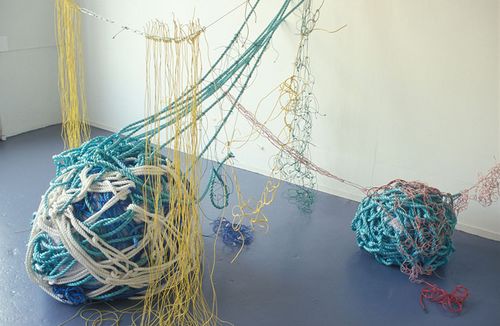
I have chosen another item that I feel has the right connotations of baggage as a new object, and the new object is rope. I started brainstorming how to photograph this idea of baggage without losing the main story of my own work, that being the connection to Kenya, and I thought of a photograph where I am still wearing the Kenyan shirt like I have been, but I am carrying a huge amount of tangled rope in my hands, as a burden, and possibly falling down and giving my legs problems as well. I would not recognize the rope in the photograph as existing on its own, because the rope is a representation of this internal burden and baggage. I chose rope because it does not have many other connotations that could be taken wrong, like a suitcase might have connotations. Its not about the physical travel, its the internal travel with these knots and burdens, which the rope is to represent.
I did think about the biggest connotation with rope, the use of it to constrict and wrap around someone, however, I feel that if I have the rope all in my hands, as I am carrying it, and not wrapped around my body, I will be able to avoid these other thoughts and connotations with the use of rope.
Here is a photograph I found (pictured above), representing a huge ball of rope that I would carry, with a few strands possibly getting tangled in my legs, as I travel in the photograph.

2.21.2010

Mark Bradford: Artist lecture

http://www.youtube.com/watch?v=rM3x0XOll30&feature=channel

The above link is a video about a piece Mark Bradford created in reference to identity and issues with struggling with something that 'obstructs' physically, emotionally, and mentally. Firstly, Mark Bradford is an American born artist out of California, and studied at the California Institute of the Arts, where he received both his MFA and BFA. His work above is a piece suggested that I pay attention to, given to me by Tom in one of the individual meetings. In this video, Mark Bradford creates a condition, a struggle, using an antebellum skirt he creates, and wears this huge obstructive piece of clothing that he then attempts to play basketball with. His piece, according to him, is about "road blocks, on every level. Cultural, gender, racial, regardless that they are there, it is important to continue, to keep going, to keep going, and so that was what it was...". This quote has stuck with me for a long time, and it has given me thought as to how this piece that I am creating fits into this notion of falling down, getting up and keeping going.
I started thinking of how my piece is similar to his, where his has a physical obstruction, and mine is all in my head. He talks about his piece dealing with many more issues than just the physical act, and that got me to think about a physical presence of something that represents the struggle. In my own pieces, I feel that this is represented by the shirt I wear in the photographs, and that ties into the pieces enough for people to realize. I also feel that my artwork creates a picture of a similar struggle that his shows, and therefore, I feel that my artwork represents a struggle, that everyone can relate to, and is not about my audience necessarily understanding what exactly I am struggling over, but that they recognize this struggle, and can draw lines to their own lives. My work, I have finally realized, is not about people understanding my struggle, its about, through my expression of my own personal struggle, other people realizing their own personal struggles and issues in their lives. Its supposed to wake them to their own self, and make them examine their lives, in all aspects, as Mark Bradford says. My pieces are created so that others can see their own things they might be running from, or are afraid to face, and now I feel that this piece should be called "Your Awakening" or something to that extent. I am continually thinking about these thoughts, and I really am enjoying this new revelation about my own work.
http://en.wikipedia.org/wiki/Mark_Bradford

2.17.2010

Artist Lecture Hank Thomas


Hank Thomas talked alot about his varying work, and jumped around a bit in his styles and focus. I do feel that one of the most important pieces that he focused on was actually how he went discussing his cousin's death. His cousin was robbed, and then killed, and he dealt with it by expressing it through a few different mediums and art styles. One way he expressed the story was through a stop motion film with action figures, and he re-enacted the whole story out, and how it happened. This of course is such a personal, and I imagine painful way to express his emotion, but in ways I feel it is similar to me, the way we both try and react an emotion of uncomfortability from the viewer, by expressing an event extremely personal to only the artist that creats it. I think the difference is that I am struggling getting my artwork of this personal matter, to be easily understood and seen in the artwork. I learned a few different things from seeing his work, and the way he presents it, so that the viewer can understand and follow. Here are some stills of his work, which he also created to stand separately from the film.


He also went another way with this, which I found even more intriguing and creative, taking the art of concept photography, and crossing it over into the world of commercial photography.
In this work, he portrays the story of his cousins death, and markets it as if it was a commercial for Mastercard. The insanity related this, at least to me, stands out like a sore thumb. The use of a slogan like this, gives me thoughts of how i could possibly market my work as if it was a product. My immediate thoughts bring about how my constant motion and restlessness could be a commercial for Traveler's and how my identity, and all the personal issues inside that deal with this work would just be thrown out the window with no regard to what it might mean. This is definitely something to keep in mind while creating work, and how someone might want to use your photography for something that it was not intended to.
Hank Thomas went on to explain how this launched him to figure out stereotypes in commercials for products of today, and how strong, and abrupt some of them still are. He also created his own pieces that resemble commercial product advertisements, yet had extremely weighted and stereotypical issues and hidden meanings. Overall, I found Hank Thomas's talk really useful in giving me more abrupt and expanded ideas about how identity and my personal issues in my work relate to the outside world.


http://81press.net/wp-content/uploads/2008/12/priceless.jpg

http://chic-cityrats.typepad.com/.a/6a00d83452021d69e201053613009f970b-800wi

2.11.2010

Idea Blog: Color transitioning


Right now, I have established that I need to focus on my color in my pieces. I recently have tried a few different techniques to combat this issue, and try to find better ways to deal with the issue. The main one I started to focus on was to use my clothing as a representation of Kenya, rather than try and edit all of the photographs to imitate shades of colors that remind me of Kenya. The main issue I had with the pieces of last semester was the connection with Kenya and the viewer. I felt like the viewer did not pick up on the hints of Kenya, because the experience of Kenya gave me the idea of changing hues and saturation to imitate shades of Kenya. If they had never been to Kenya, then that specific ideal would not be conveyed at all. So this semester I did some brainstorming of ways to use color to better influence each individual piece. My first idea was with my clothing, as I stated earlier, focusing on a shirt I own that is the National Kenyan Jersey for their rugby team. It clearly shows the flag colors, as well as the flag pattern as the main part of the Jersey, and I decided that the images would be unified by all having those bright and distinct colors and shapes, and that would somehow connect all the pieces. I thought of having a photograph where the shirt is close enough in the photograph so that the viewer can identify with it and directly point it out. I also thought about giving more emphasis on this by giving a gradient of color to black and white from the shirt out into the environment phtoographed. This would also help to influence the idea of separation that I feel internally from the environment I am in now, and give the influence of a 'trying to blend' effect, as if the two identities were trying to mix in this 'one-identity' photograph. They are both competing for the attention, and this is the result of their fighting, a confused and separated photograph. The pictures at the top are examples of what I worked on. I will continue to deal with this issue, trying to iron out a successful and solid idea for uniting the photographs, both in color, and in conveying of the concept.

2.08.2010

Artist Blog: Paul Himmel


(Brooklyn Bridge, circa 1950, Himmel)
(Grand Central Terminal, 1947, Himmel)

Paul Himmel is an artist from the mid-twentieth century, whos work I draw direct connections to my own work. These two photographs directly relate to my work that I have done throughout my artist's experience. The photographs he captures clearly focuses on an emotion, a feeling, an internal struggle for the one that is the focus for the photograph. Paul Himmel was born in New Haven Connecticut, was an immigrant with the rest of his family from Ukraine, and got a degree in Science. He started teaching himself photography, and eventually started working with a professional. He eventually gave up photography and became a psychotherapist. His pieces inspire me because I see so many strong connections to his photographs, as if I had stolen the idea from him. He photographed what I would call hidden photography, capturing successfully emotions and feelings that react all viewers on a personal level, touching a sensetive subject that could be any number of things. The photographs directly speak to me because he captures what I feel through my own photography, the separation, the loneliness, and the blinded friends or people of the world that cannot, or do not understand or connect to his emotions. The main problem with this type of photography is that the photographers will use the medium to convey the separation, and the inner struggle to others, but the people still don't seem to ask or try to understand the emotions behind the person, they just understand that he or she feels alone, separated, and unreachable. I feel that my photography will try and breach that gap, with the use of actual travel, the motion of walking, and the use of bridges as a way to connect with both the viewer, and the inner struggle to which the problem subsides from. This by no means is a solid idea that I am running with, however, I do feel that progress is being made, and that continuing on this path will lead to more successful, beautiful, and strong photographs.


2.03.2010

Idea Blog: A Bridge and a road

The two things that I feel I need to focus on to constantly improve and push my work this semester right now are bridges and roads. Firstly, it is important to understand the function of each thing first in the real world. Bridges are structures that provide a passage over a chasm or object of impassibleness. For me, this takes on a meaning far past just the physicality of a bridge in real life. To me I focus on thoughts of a connector or a way to pass between my two identities inside of me peacefully without struggle and conflict. I feel that the whole reason why I create work that focuses on my identity is because there is no there between the two sides of my life, and will always feel separated and singled out unless I portray the emotional stress and struggles of dealing with this obstruction. In my imagery, I feel that a bridge would depict beautifully my connection between the physical imagery depicted in the photograph to represent the intangible meaning behind my photographs.

Another word that is related, but can mean or depict various other things, is the use of roads. Roads are simply defined as a stretch of land that has been set separately for travel, normally between two different points. This relates to my work as well, because I feel that the road between my two identities has not yet been discovered, and that I am searching for it through my imagery. The road needs to be built, but it cannot be built without understanding if both sides. Travel is also a clear signal from roads, and because I traveled, creating this alternate identity, I feel that travel and exploration have huge issues and points that relate to this. My challenge is now, how to depict the use of roads and bridges together, without overpowering the imagery, and how do I keep the images unique? These are my challenges with thinking about these issues specifically, and the above photograph is something I took before really diving deep into this work, and will hopefully be a rough draft compared to what I will make out with in the end.

2.01.2010

Daniel Lobdell - Artist Blog


Spanning Structures 04-P10, 2004 , Spanning Structures 08-SP08, 2008

Daniel Lobdell is an artist I recently have come in contact with, due to my changing imagery as I progress with my work. He is an American photographer, born in 1969, and graduated with a Master in Fine Art in Photography from Tyler School of Art at Temple University. Recently, his work has been viewed and put up for show all over Philadelphia, where he currently resides. The reason I am focusing on Daniel Lobdell is because of some of his photography that directly relates to the issues I am dealing with in my own pieces. The two above pieces, deal with a few techniques that I need to address in my own work, one being the choice of color. Previously, my work focused on having a tint of Kenya towards the photographs, something that reminded me of pigments and hues that I would designate as representative hues for Kenya. The trouble I had dealing with this style was the small differentiations in tints and shading, struggling to get a uniform gradation. I have taken a few photographs in black and white, and I still am not sure how they change the imagery of my own and I plan to continue to search for a solution. In relation to these images, I feel that color might have changed the meaning and feel of the pieces, and I enjoy the choice of absence. Especially in the top one, there are hues there that hint to pigments I remember from Kenya, and I want to try a mix between black and white, and color.
Another issue his photography confronts is the bridge itself. Bridges started interesting me after I photographed myself crossing a bridge. Being that a bridge relates to a connection between two different ideas, I started thinking of my own search for the connection, the bridge, between my two identities. In Daniel Lobdell's imagery, the bridges are not photographed from on or next to the bridge, in fact they are from below, and that intrigued me, and got me to think about the use of bridges in my own photography. Did I have to be standing or crossing on the bridge for the concept to make sense, or could I use the twisty and winding undersides of bridges to show my confusion and situation with my identity struggle. I am continually thinking and pondering about these images, hopefully getting an answer or clue that will further push my idea.


1.27.2010

Artist Lecture: Alec Soth

Alec Soth is a photographer born in 1969, who is based out of Minnesota, and has been recently established after publishing a few different books of his work. A few different series of his stood out to me in his presentation, including his most noticed, Sleeping By the Mississippi. This series of his work established a long series connection with photographs all somehow relates to each. The connection between each of his photographs is not necessarily pictured in the photograph, but is contextualized through interpreting the imagery. Here is an example from his series:

Fort Jefferson Memorial Cross, Wickliffe, Kentucky 2002


Charles, Vasa, Minnesota 2002
This body of work made me question exactly why we connect photographs in the way we do, and if we really think through all of the photography we create as to how it relates to the rest of a particular body of work. In the above example his connection between the two photographs was the second man from the left in the first image wanted to have his own flying school, and the planes in the second photograph suffice the connection. This connection would not have been known by the viewer just visually looking, which made Alec think about how work connects with each other, and how important the story behind the image is. I looked at my own work, starting to think about how i am connecting and drawing lines in my own work. His pieces made me realize the importance of how, and what kind of a connection is made between pieces of art, and how that might affect the piece.
He went on, discussing how this pondering of connecting stories and themes reminds him of a story that gets told within imagery. Alec started to focus on a desire for narrative in his pieces to tie them together. This discovery led him to two different pieces, both narrative in nature, one being The Most Beautiful Woman in Georgia, and The Loneliest Man in Missouri. Both pieces interested me because i felt, especially with The Loneliest Man in Missouri, a strong connection to my own work, and how i am making a narrative in my own pieces, where i am "the loneliest man" only in identity rather than meer physically. I feel that his pieces cross much deeper past his titles as well, where the viewer has to really dig for the meaning in the titles given because there is a hidden meaning relating back to the narrative in the piece. I feel that he also has given me a new found respect for titles of pieces, and i will think about how to approach my own piece and title.

1.25.2010

Artist Blog: Michael Kenna

Michael Kenna is a recent artist i discovered while revamping myself into the work i will continue to do this semester. He is a British born Photographer who attended numerous schools in England to pursue his photography. He currently lives in Seattle, Washington, in the States. His work, after closely examining it, is extremely similar in emotion i get from my own pieces. His are purely landscape photography, and beautiful black and white prints, however, his pieces speak to the story behind the image. Each shot seems to tell a puzzle of the piece, or leave the viewer questioning the meaning behind the piece. The photographs tell of a place, and then hints at an underlying story within the piece. Originally, I saw very little connection between his and mine, however, as I kept staring, and taking in the images, i realized that without any human imagery in the pieces, he still conveyed the feeling similar to what I try to give off in my own imagery. The difference between the imagery is that my photography and concept benefits more with my own person in the images, whereas Michael Kenna's focuses on the landscape only to tell the story.


Here are two images that I find relevant to my own images.


Ponte dei Sospiri, Venice, Italy, 1987 Gondola Ferro, Venice, Italy, 2006
These pieces also have given me thoughts of toiling with film and black and white imagery. I feel that the manipulated color in the photographs I took for last semester worked to a degree, however, with slight variations in tone quality, it would be hard to reproduce for so many photographs. I think color is something i need to focus on, however, I am still unsure how to approach the issue, and will continue to contemplate various possibilities.

12.10.2009

Idea Blog: Finalized

In my final images, i have been rephotographing the actual first prints of the pictures that you have seen on my blog before, and at the same time, incorporating dirt into the imagery. I will be taking dirt that i have collected over this semester and using it to outline the photograph, and creep into the image in parts. I want there to be a sense of misplacement within the imagery. My final pieces will not be something easily understood by all viewers, partially because the concept still has more work to be continued with and altered slightly, however, i will hope that the feeling I portray through the images create a sense, a feeling within each person about their past, and feelings related to similar ideas, even if those feelings are hard to describe.
My final ten pieces each have a main point that i took the photograph about. The ten aspects are:
Location
School
Family
Friends
Home
Travel
Shopping
City Business
Food
Wealthiness
The pieces remind me of what i feel each look like, and are not necessary to understand the pieces. The whole piece emphasises my misplacement here, and in these ten different characteristics are my experiences here. The dirt, color correction, and my presence and aura given off in the imagery is my hidden identity telling me that there is something missing. I thought about posting images, however, i will on my final blog post, after the assignment is due.
Good luck to everyone!

12.07.2009

Artist: Chuck Close

Chuck Close, born in 1940, is an American photorealist that paints with the finest air brush style, and creates magnanimous head portraits and self portraits. By looking at his work, i have noticed that his images deal with identity and issues focusing around people and their perspectives of others.
Here are a few examples:
These photographs are each individual and unique, and to me it speaks towards a different side that i see of that specific person in the photograph. The photographs are each focused in a very small and detailed area at a time, in a type of unique and abstract painterly style.
His photorealistic style of imagery is almost covered in a 'truth veil' giving the image of what would be a normal portrait, a type of filter that shows a kind of imaginary truth that is revealed from the original person .

12.05.2009

Two Art shows applied for:


The first one i applied for, as i told Paul, I sent in to the VMFA, however, the return postcard was lost.

The second show i applied for was from www.winterfood.org. The winterfood project was about awakening people in the community about the produce that the greater richmond farms produce during the winter. The below is the photograph i submitted.

I am constantly looking for more art shows to apply for.

12.03.2009

Idea Blog: Recent updates


I have continued to work with large images of things that inherently remind me of America, and a notion of the developed world here, using imagery such as malls, buildings, and large landscapes with buildings surrounding. I am in the picture as well, though i am represented as something missing, being disconnected and overwhelmed by the massiveness of the developed and uncommon imagery. Some photographs are numerous images put together, and add to the intensity that makes me as somewhat unnecessary and very small.

These following images are representative of what i have most recently done.

I plan to take these images with some sort of interaction with dirt, as being a symbol of something there that people have to look through and look past, with the dirt, without them realizing, actually holding worth and value within the composition. I plan to photograph on other imagery that i find that resonates with different aspects of life, such as Family, Student, Place, Wealth, etc. and have decided that using ten images that each represent one of these core values, as the imagery i show for my final.
I am still thinking about the usage of dirt, especially because my piece will not be experienced by other classmates, and only submitted as prints. I also need to think about the aspects of life that i have, and how they resonate with me, and have meaning within my life.
The whole plan is to have these images of values of human life, with me in the images, as expressing something that is missing from the values, and that missing emotion, feeling, or concept is representative of my past thoughts from Kenya.

11.30.2009

Artist Blog: Alexandra Catiere

Alexandra Catiere is a Russian-born artist who lives in New York mainly focusing in fine art photographs. She has focused more recently in fashion photography, and the colors, textures, and physical attributes affect a photograph, however, it is her older work that i am mainly intrigued by. Her older photographs in a series titled 'Behind the Glass' is my main interest, especially being that my work has now pushed itself to incorporate glass. I figured that i could possibly draw some insight on how i could use glass in my own photographs.
Here are some of her images. She took these photographs in the city of Minsk, where she was raised, and said that their focus was about a disengagement of the glass on a bus window, and how the glass framed the faces behind it, almost taking them out of the real life context. To me they tell a story, and i really enjoy how the glass becomes a part of the piece. I want the glass in my own work to be a part of the piece, however, establishing and connecting them will be difficult. I do like the thought of window after window, like a bus would have, however, i am then not sure as to how the dirt that is incorporated into the piece will be so tactile and interactive. I do plan to hang my photographs behind glass, or with glass ontop, however, how will the sand become part of the piece? Should i even have sand? Maybe a faint photograph printed on the glass would be more beneficial. WHat should the picture on the glass be of? I had originally thought of the glass photograph as being one from Kenya, however, i am not sure if such a direct route is neccessary. I have thought of printing on the glass a replacement of what the picture might look like in Kenya, for example, instead of a parking lot full of cars, a dirt wasteland. Things i am still debating now, that i need to finalize.

http://alexandracatiere.com/

11.23.2009

Sorry its Late: Idea Blog


Recently, i have been continuing with issues to do with my identity and this world. I am still struggling with issues to do with exactly how to depict this idea, however, i finally think that i have found a way to successfully do this, and i think it has been the best idea yet.
What i am focusing on are some relatively large pictures focusing things that ar, to me, inherently American. In the photographs, i am also shown standing looking at a construction or scenario that says 'America' to me. With these photographs, i alter the color scheme to match what looks inherently Kenyan in color and placement of color. The photographs then will somehow have an overlay of something like dirt on glass, that sits in front of the photograph. The viewer will interact with the dirt, and move it, pushing it away to see the image behind the photograph. In doing this however, the viewer is interacting with what matters in the piece to get to the imagery that doesn't matter in my concept.
I also have had thoughts of printing very vague images onto the glass as well, of something that is Kenyan and reminds me of Kenya, therefore the viewer is looking through the important to get to the normal and unimportant.
The photograph above shows what one of the photographs might look like. I am standing facing this huge monumentous imagery of America, and over this photograph, there would be glass, possibly with a photograph lightly printed onto it, or some dirt that the viewer has to react with, or both.

11.19.2009

Artist Blog: Edith Lechtape

Edith Lechtape was born in 1921 in Herne, Germany, and started out her career as an actress under Heinz Moog. She then went to work for a few different theater houses around in Germany, for a number of years. She did this for almost twenty years, until she came into contact with Antoine Weber, who had been immersed in Photography for about twenty yeard by then. He encouraged Edith to explore the photographic realm as method for expression. She mainly focused on pieces involving photographs, painting, and drawing in pieces.This idea of layering goes with my main focus in my own work. My work has recently delved into issues about layering, and this type of work was what immediately attracted me to any thoughts that i had for my pieces. A mixture of resources and materials layered onto surfaces ontop of my photographs is my main focus for the rest of the year. I will continue to search for artists with this type of style, hoping to find some more techniques and thoughts of how to layer.

http://www.kulleraugen-verlag.de/elaw_2.jpg

http://www.allein-fuer-dich.de/gossenportraits.jpg

11.15.2009

Idea Blog: Kenyan Items


I recently rethought my concept, partially because of issues with me constructing multiple objects that remind me of Kenya. I have really struggled in constructing objects, being that they both take so much time, as well as the thought that the construction of the objects moves the concept away from what i want. Even though it is my own construction, i feel that it cannot be seen through the photograph, without videotaping it, and then, i feel i cannot portray the item properly. Recently, with photographing backgrounds, i have gone home, and looked for things that i and my parents brought back from Kenya, and am currently photographing myself using them in everyday use. For example, i am using a pot with a spoon on the stove, rather than a regular pot and spoon. I have lost my inspiration in doing this, and i am not sure how much i like doing what i am doing. I have been thinking and shooting, trying to find a better way to portray my concept, unfortunately, i do not feel inspired to continue this concept. My photographs are turning almost to comical antics, showing different characteristics and sides of different lifestyles. I am not sure if this is good or not, however, i feel different to how i started at the beginning of my concept.


These are photographs of some of the objects that i am currently using.
I will just continue to photograph. If there is one thing i have learned, is that taking photographs is the best way to solve any problems.


11.12.2009

Artist Lecture: Shimon Attie

Shimon Attie was born in California, and lived there for his childhood. He originally started studying psychology, however, moved towards photography and art after a short period. He graduated from San Fransisco State University in 1991 with his MFA. Shimon has some Jewish heritage in himself, and because of that, he first started his focus in Germany, and Europe, thinking of the Holocaust, as well as much more recently, the tearing down of the Berlin Wall. He moved to Germany to work on these concepts and thoughts he had in his mind. His first series focused on what was in Germany, mainly East Germany, after the wall was torn down. His piece focused alot on the issues of pre-World War 2 history, as well as the dark years after the war. There are remeniscents in his pieces, as well as from reactions of people around the area towards his work when he had it. His experience was truely unique in this project, and his use of sometimes multiple projectors and historic imagery really played well together. His pieces remind me of issues in my own work, and the thoughts of the past and how it is different now to the present. This work i most connected to, and i actually would like to try using projectors in similar ways that he did in his imagery.


His later work dealt with pieces of time, the first being in Aberfan, and the second being about a raceway here in the U.S.A. His work dealt alot with movement, in being that the characters in the video stayed still for a few minutes, while the platform they were on moved. This was a video, and he did not use stills to benefit his work. I found less of a connection between this work and my own, however, his work did open my eyes to the numerous tools and techniques that an artist can use time to affect both the viewer and the piece itself.

http://www.matthewlangley.com/blog/uploaded_image/Shimon_Attie_Untitled_Video_Still_Racing_Clocks_Run_Slow_Archeo_1221_73-742525.jpg

Idea Blog: Projectors, Layers

I recently came into contact with an artist that came to visit VCU, and he has given me some ideas on how i can keep developing my project this year. His name is Shimon Attie. His earlier work has alot to do with projectors and this idea of projecting something into and on a space, which has significance within the space, as well as dealing with the past, present, and future. I have started to think of similar ideas that i could construct myself in the pictures i create. I thought of putting up a landscape like that of Kenya onto a building, while i react in some situations with the constructions i have been making. I have thought of putting up photographs, making them into slides, or transparencies, and then putting those up on walls for people to see. These are just beginning stages of thoughts, however, i really like how overlays can construct a story for the viewer within an image.eally like the idea of layers onto one thing.
So the idea of projectors come into play, some being slide, some being transparency, and others that are extremely high tech. These objects symbolize to me and my work, as a 'portal of truth imagery', meaning, showing somebody's wishes and hopes, their true past, what they wish for, and so on. These will normally not mean more than one of these things, partially because they would run over into other categories that might confuse the viewer.
The image itself that is portrayed through the machine is the truth, the past, the future, the persons hopes and dreams, the inevitable, and so on. I really like the idea of portraying things onto myself that remind me of Kenya. The identity issues are still very strong in my work, however, i feel that i want to test out this theory of projecting things onto myself, and other things. It sounds interesting, and could be a branch of my artwork for anothe time.

http://www.mocp.org/collections/permanent/uploads/Attie2002_180-thumb.jpg

11.09.2009

Artist Blog: Manfred Leve

Manfred Leve was born in Trier, Germany, he grew up in Dusseldorf where he studied law, middle eastern cultures, art history, and philosophy at select universities in Germany. Since his graduation, his focus field has been in working as a lawyer. He currently works for the Federal Institute of Labor in Nuremburg.
His inspiration and love in the arts had him jumping in the art scene at a young age, in his schoolboy days. This was where he first started using a camera, mainly for documenting and recording events in the art world. While still relatively young, he became introduced to Sigmar Polke, and started shooting him, both his life and his work.
I have found Manfred Leve's work to be very story driven, even if the photographs are of people looking at art and people admiring art. His work i feel has much more of a hidden meaning. They all seem to have their own story in each one, as if from a film still, where the viewer gets caught in a moment of sheer excitement and tension, yet do not know what or how the story will play out. I feel that Manfred Leve knew this about his work and he was able to carefully frame and 'catch' people in the moment, creating a story from one photograph that the viewer takes in and tries to understand.
This type of storyline photography is partially what i find interesting, and want a similar storyline. I feel that i will physically have to find someone else to take the photographs for me, because it is the only way i can act natural, as well as having the best chance to portray this same emotion coming out of Manfred Leve's work as well.

11.05.2009


These pictures are of cut glass that has been cemented into the top of walls, mainly used as a deterrent for people from breaking into the houses inside of the fence. I find these cut shards of glass as very important and visually interesting pieces of my childhood that i remember. These pieces of chipped bottles, and smashed glass remind me alot of the dangers of where i lived, and the situation we lived in, in relation to a wall, cut glass, and electric fencing. We also had a guard that watched the gate 24 hours of the day, which i found very interesting, and yet we still had our houses broken into. Safety there is a whole issue there, because of protection, and safety of your own life. There is no place where you are safe, even the police there are drunk most of the time, while they are working, and will try and pull people over to get them to give them money for them (the police) to buy more alcohol.
The situation there was terrible, and trying to connect it to a physical presence i feel requires me again to construct the cut glass in cement. The Rungu, which i am still working on (believe me, it takes a long time and quite a bit of effort to construct an object such as that) and the cut glass in cement, will both be in the photographs as well, in context as to which they would play in everyday life in Kenya.
My newest thoughts on these constructed pieces involve me taking photographs of me interacting with only one of these objects at a time, such as suggested during mid-term critique. An example of what i mean would be playing soccer with the plastic bag ball that i constructed earlier in the year. These shots would be in the moment, and i would want to be the one playing with the object, so i might get someone to take these photographs for me.
I thought of some of the objects in their context to life here: the dirt would be on the road, like pavement, the rungu would be in court/at a courthouse, and the plastic bag soccer ball would be on a field, and this is the direction i feel most drawn towards.

11.02.2009

Artist Blog: Andy Goldsworthy


Andy Goldsworthy is a British artist, photographer, and environmentalist sculptor that lives in Scotland. He studied at the Bradford College of Art in fine art, who was born in Leeds in 1956. His work is heavily nature based, and his pieces often involve time in almost unrealistic scenes, and outstanding outcomes. His pieces remind me of the almost vulnerable nature, in which we enact and react with in a constant basis. His pieces often do not last very long at all, because nature breaks down the pieces. His pieces are of nature, made from nature, and are destroyed and deconstructed by nature.
Here are some pieces that i find extremely inspirational and even though his pieces do not directly relate to my pieces, i still see similarities in between my work and his.
His pieces are heavily focused on nature and its presence on work. Whereas in my work, i also show heavy influence on presence in the world, yet instead of nature and its fleeting way, mine is focused more on the fleeting of me and my identity.
I watched a documentary on Andy Goldsworthy, and just a visual viewing of him and his artwork really inspires me to pursue what i want to do in my own work. I find his pieces also very emotionally reactive, and when i see a piece melt, or change color because of its exposure to sun, i almost breakdown, because of his hidden meaning in the fleeting of nature in our world. This reaction is very similar, i feel, to what i want to react from my artwork, and i urge everybody to pay attention to Andy's work. I find his work somehow inspirational for everybody, and i urge you also to watch documentaries on his work, because of his outlook on life, and nature.

http://www.woostercollective.com/images2/gold_treesoul.jpg
http://classes.design.ucla.edu/Winter09/9-1/blog/b/wp-content/uploads/2009/03/andy_goldsworthy_rowan_leaves_with_hole.jpg

10.29.2009

Idea Blog: Background Hunting


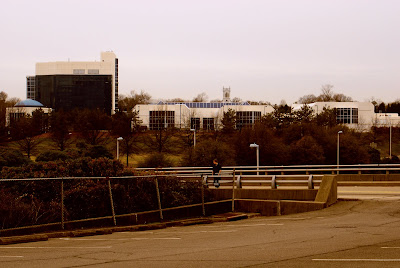
One of the biggest humps i need to address in my photographs is an issue of background. People said that the background was too distant from the action occurring in front of the background. I still want to show the idea of separation between the 'developed' and American background, but also has color, shades, and textures of those that remind me of Kenya. Here are a few test shots that i took, while i was searching. I feel these might function much better together with the concept and still resemble the imagery of a bustling and busy 'developed world' background.

These photographs i took quickly as i was exploring, and they feel like they would work much better in my concept than the ones used right in the city. I will continually search for more locations, and edit them, changing their colors in photoshop to match colors and tints that remind me of Kenya.
Some key pieces in here that are characteristics important in the background are broken, and cut down fences, splitting and neglected pavement and dirt, and an overall yellowy tint to the trees and grass.
I don't mind the blue sky because i feel like that resemble the city in the background.
I will continue to shoot and search for locations.